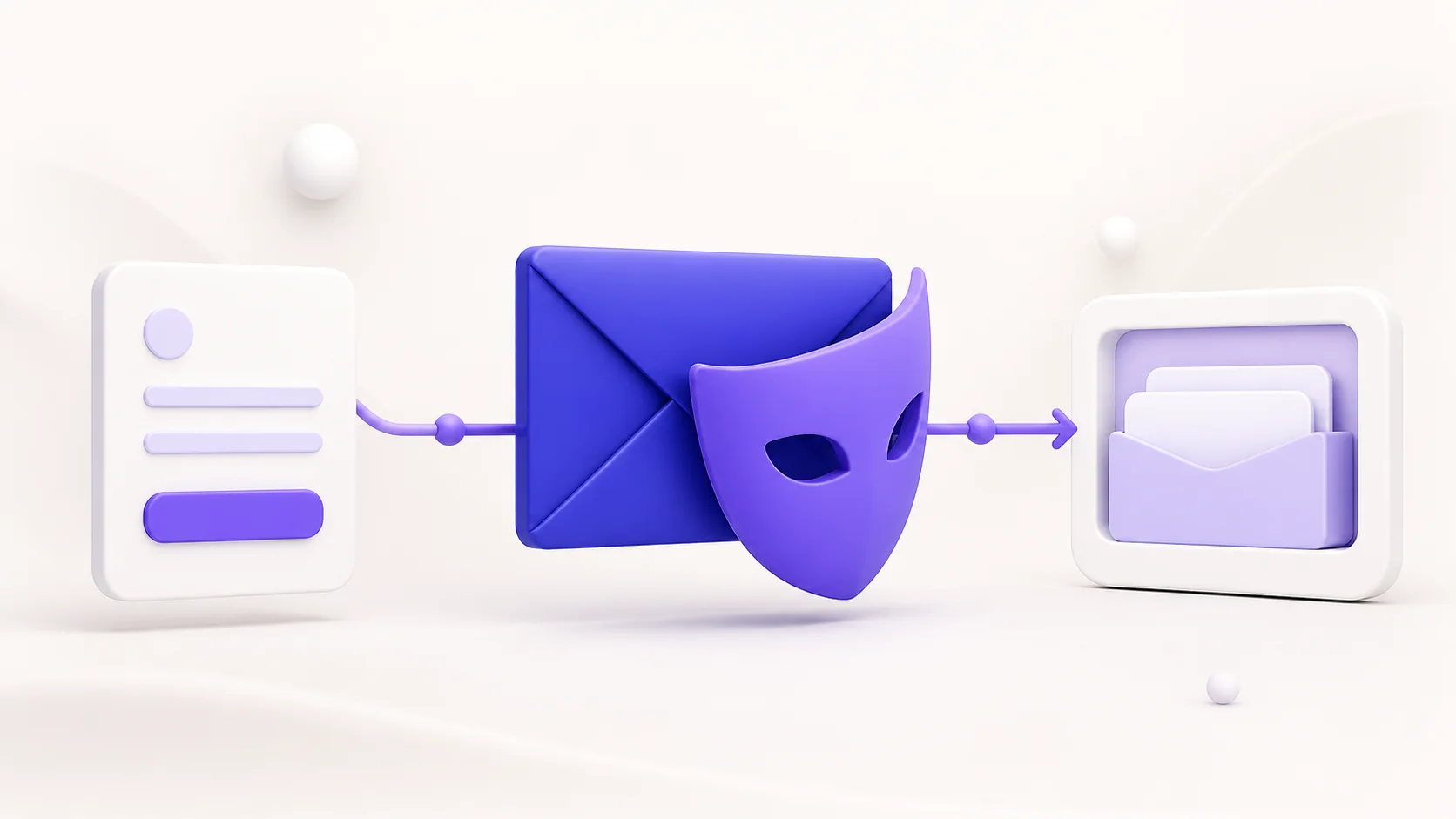
A burner email is an email address used for a limited, specific purpose instead of as your permanent inbox. People use one when they need to receive a message, confirmation link, or one-time code but do not want that website to have their primary email address.
The term “burner” describes short-term use. It does not mean the address is anonymous, exempt from a website’s rules, or appropriate for sensitive information. A burner email is best treated as a practical privacy tool for low-risk tasks.
For the broader concept, read our guide to temporary email and how it works.
What is a burner email?
A burner email is a secondary or disposable email address that separates a one-time activity from your main inbox. It may be a short-lived temporary inbox, an alias, or a separate mailbox that you only use for a specific purpose.
The right option depends on whether you need the address again. A temporary inbox can be useful for a brief, low-risk interaction. A separate permanent mailbox or alias is better when you expect future account messages, receipts, password resets, or customer support replies.
How does a burner email work?
- Choose an email address that is separate from your primary inbox.
- Use it only for the specific website, test, or sign-up you have in mind.
- Receive the needed confirmation message or code.
- Complete the low-risk task.
- Stop using the address when it is no longer needed, or keep it only if you need future access.
A temporary burner email is especially useful when you need to read an incoming message but do not need to send replies or maintain an account over time.
Burner email vs. temporary email
The terms overlap, but they are not always identical. “Burner email” describes the purpose: keeping an activity separate from your regular inbox. “Temporary email” usually describes the lifetime: the inbox is intended to be available only briefly.
| Type of address | Best for | Should you rely on it long term? |
|---|---|---|
| Temporary inbox | One-time, low-risk confirmations | No |
| Email alias | Separating newsletters or a recurring service | Yes, if managed securely |
| Secondary permanent mailbox | Ongoing accounts that you want separate | Yes |
| Primary inbox | Important accounts and recovery | Yes |
When is a burner email useful?
- Trying a free online tool you may not use again.
- Receiving a low-risk confirmation link for a one-time action.
- Testing a registration, contact form, or email flow during development.
- Keeping promotional messages separate from your personal inbox.
- Giving a short-term event, download, or trial its own email channel.
These uses are about inbox organization and limiting unwanted follow-up messages. They are not a reason to ignore a website’s terms or create accounts that violate its policies.
When should you not use a burner email?
Do not use a temporary or disposable address for anything that could affect your identity, money, security, or future access. Use a secure permanent inbox for banking, payment services, government accounts, healthcare, work systems, education platforms, travel bookings, subscriptions you plan to keep, and password recovery.
If losing access to the address would be a problem, it should not be a temporary burner email. The same rule applies to messages containing private documents, account recovery links, sensitive personal data, or confidential information.
How to make a burner email safely
Start by deciding how long you need the address. For a single incoming confirmation, open a temporary inbox and use it only for that task. For a recurring service, use an alias or separate mailbox that you control and can access later.
Before entering any email address, check that the website is legitimate. A burner email can reduce unwanted mail, but it does not make suspicious links, downloads, or phishing attempts safe. Never enter a password, payment detail, or personal document into an untrusted site.
Can a burner email receive verification codes?
It can sometimes receive verification emails, but delivery is not guaranteed. Some services block known disposable domains to reduce abuse, duplicate registrations, and account-recovery problems. Others may delay or filter the message.
If a verification code relates to an account you care about, use a permanent inbox. For a short-lived task, a temporary inbox may be appropriate. Our guide on 10 minute mail explains why the lifetime of a temporary address matters.
Why do websites block burner or disposable emails?
Many websites need a reliable way to contact account holders later. They may block disposable domains to reduce fraud, spam, repeated free-trial registrations, and support issues caused by unreachable accounts.
A blocked temporary address is not necessarily an error. Respect the site’s policy and use a regular email address when the service requires a long-term, recoverable account.
Is a burner email private?
A burner email can improve privacy by limiting where your main address is shared. It does not guarantee anonymity, secrecy, or protection from unsafe websites. The level of privacy depends on the email service, the website you visit, your browser, and the information you provide.
Use the minimum information needed for low-risk tasks and avoid sending sensitive details to any temporary inbox. For more context on what disposable email is and is not, see why Gmail is not a disposable temporary email domain.
Frequently asked questions
Is a burner email illegal?
Using a secondary or temporary email address for legitimate, low-risk privacy and inbox-management purposes is generally normal. However, you must follow the rules of the website you are using and never use an email address to commit fraud, evade restrictions, or harm others.
Can I send emails from a burner email?
Some secondary mailboxes can send and receive email. Many temporary inboxes are receive-only. If you need to reply or maintain a conversation, choose a permanent secondary mailbox instead.
Can I recover an account with a burner email?
You should not rely on a temporary address for account recovery. Use a secure, permanent inbox for any account you may need to restore later.
Is a burner email the same as a fake email?
No. A burner email is a real address used separately or temporarily. Avoid using false identities or attempting to bypass a website’s requirements.
Use the right email for the task
A burner email is useful when the task is brief, low-risk, and does not require future access. For important accounts, use an email address you control for the long term.
Open a temporary inbox with MailsDrop or browse the MailsDrop guides for more email privacy advice.